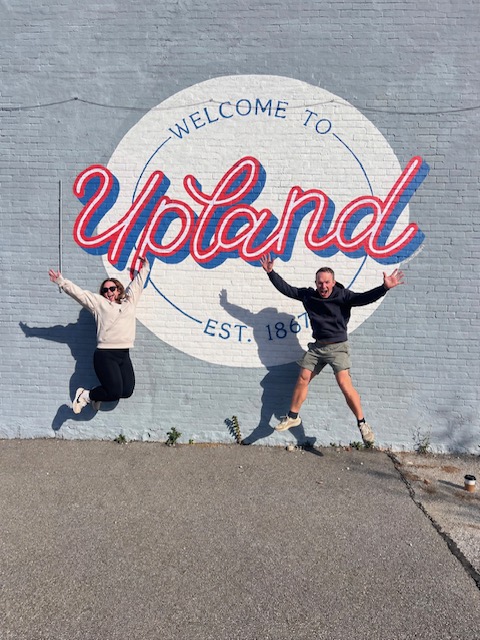
Our family ventured to Upland, Indiana, this past weekend to watch Sydney play her senior soccer game. Upland isn’t anyone’s booming metropolis. With the population just topping out at 3,800 people, it’s one of those little Midwestern towns that often pass so quickly that if you blinked, you’d miss it.
We had the chance to walk through much of the town, stopping at little shops that offered cutesy collectibles, and walking past the apartment building that’s no longer an apartment building where our daughter and her husband lived her last year at Taylor. We stopped at a unique coffee shop that had the best pastries you could imagine–owned by a couple from Bradenton, Florida. Everyone we met was kind, friendly, and welcoming.
It’s what you often find in small towns. My husband grew up in a community with only 1,500 people, and everyone there knew everyone else. He had teachers who had taught his dad. When he filled his car at the gas station and bought groceries at the local store, he put it all on a tab. That kind of community trust doesn’t exist much anymore. It brings to mind “Little House on the Prairie” and “Anne of Green Gables”. Small towns where everyone knew the neighbor’s business.
For centuries, small towns have existed with locally owned businesses and people trading goods for services. Tight-knit bonds defined community relationships.
Jesus was born in Bethlehem, a tiny, compact settlement of about 300 people, about five to six miles south of Jerusalem. A place where everyone knew everyone else. A prophecy written around 700 BC by the prophet Micah tells how Bethlehem would be the birthplace of the anticipated Messiah. “But you, O Bethlehem Ephrathah, so small among the clans of Judah, out of you will forth to Me the future ruler of Israel, whose origins are far in the past, back in ancient times.” (Micah 5:2) The smallness of this tiny hamlet compared to the greatness of its destiny.
It was a well-known fact that this small settlement would be the birthplace of the Messiah. King Herod, despised by the Jews, had become king by Roman decree. When the Magi showed up–men who were part of the priestly caste from Persia–and asked where they could find the King of the Jews, Herod was afraid of the possibility of someone taking his throne. When he asked these philosophers where the birth was to take place, they said, “In Bethlehem in Judea,” and quoted Micah 5:2. This King would be born in this very small place, only five to six miles from where his palace was.
He was so incensed by the chance that someone would usurp his throne, especially once he realized the Magi escaped without showing him where the baby was, that he sent forces to Bethlehem to kill all boys two years and under. For the size of Bethlehem, the soldiers would have slaughtered about twenty children.
Small town.
The beauty of small towns is that everyone knows everyone. In Upland, everyone is aware of what happens at Taylor University; it’s very much part of the fabric of their lives. In Bethlehem, the people there grieved with one another, for the loss of those children impacted them all.
There’s a unifying atmosphere when neighbors can celebrate and grieve together. Sharing in life together. There’s a trust factor there that feels harder to come by today.
We still need that trust.
How do you reach out to others around you?


Leave a Reply