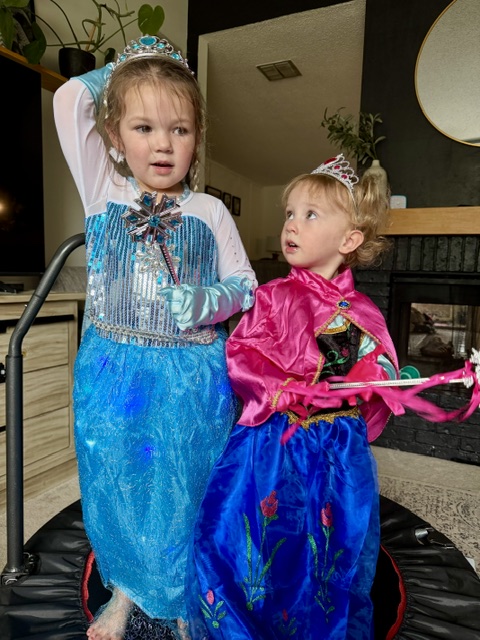
Kolly and Thea love to dress up as princesses. The magic of royalty has captured their imaginations, and they play as if they’re truly royal. When you wear the crown, there are privileges.
Or at least, they think so.
When I see the girls dress up like this, I understand their view of being a princess if it’s based solely on Disney’s take on such characters. They have morphed over time from damsels in distress to strong women willing to fight for what they believe is right.
The princesses are always the center of the story.
Most of us have a fascination with royalty as well. In 1981, an estimated 750 million people in 74 countries watched the marriage of Diana to Prince Charles, when she officially became a princess. She fascinated people all over the world; she was a princess of the people. She was deeply compassionate and broke away from the traditions of the royals, connecting with those who were often unseen by others.
It’s estimated that 2.5 billion people watched her funeral worldwide. The world mourned her passing.
We’re fascinated by the royals snubbing their own, by their wardrobes, and by their attitudes toward their own countrymen.
We have never had a king in this country; some have thought several presidents have sought that kind of status and control, but it hasn’t happened yet.
Power can be a frightening thing. One of our earliest presidents, John Adams, once said, “Because power corrupts, society’s demands for moral authority and character increase as the importance of the position increases.” Edmund Burke, an Anglo-Irish writer, philosopher, and politician, once stated, “The greater the power, the more dangerous the abuse.”
Israel learned this the hard way. God was their King who rescued them from bondage in Egypt, who led them and sustained them across the wilderness to their new home, and who helped them settle into their Promised Land. Moses and Joshua, his successor, helped the people become established in their land. Then, for about 350 years, the people were ruled by a succession of judges, military and spiritual leaders who delivered Israel from raids by foreign oppressors.
But the people became unhappy when the final judge, Samuel, became old, and his sons weren’t fit to lead Israel. “Look,” they told him, “you are now old, and your sons are not like you. Give us a king to judge us LIKE ALL THE OTHER NATIONS HAVE.” 1 Samuel 8:5.
Samuel warned the people of the dangers of having a king other than God. A king would draft their sons into his wars, make the people plow his fields, and take the best of their own fields and vineyards to pay his officials. He would take their servants, a tenth of their flocks, and the finest of the people’s cattle for his use.
Nothing would dissuade the people. They wanted to be just like the nations around them. So God gave them Saul, a physically tall man who did everything Samuel said he would do. And more. But he disobeyed the Lord. “Then the LORD said to Samuel, ‘I am sorry that I ever made Saul king, for he has not been loyal to Me and has refused to obey My command.’” 1 Samuel 15:10. Saul tried to explain his way out of how he deliberately defied God. He becomes seriously depressed and feels his own son betrayed him with the man who would replace him. In all of this, Saul was most concerned about how people would see him.
People are fixated on royalty because of their privilege, pomp, and presence before their people. It’s also because, at some level, we wish to be kings and queens of our own lives, in sovereign control of all that happens to us.
Royalty will always fail us. We don’t control life. The only true King, who will be the same in His truth yesterday, today, and forever, is God. “All honor and glory to God forever and ever! He is the eternal King, the Unseen One who never dies; He alone is God.” 1 Timothy 1:17.
He’s the one we should be enamored with.


Leave a Reply