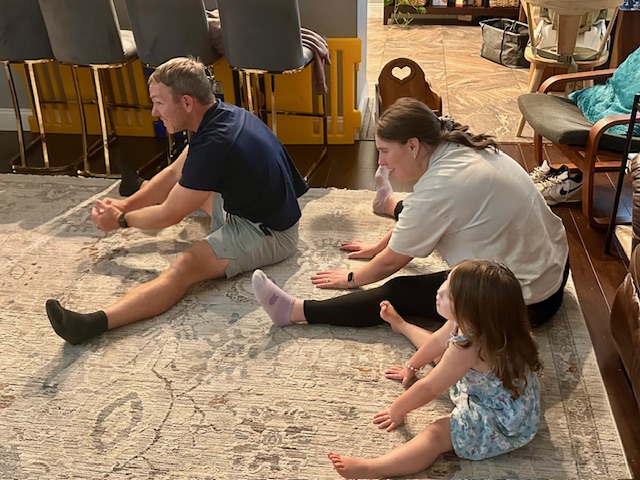
There’s nothing more fun to watch than a child exercising with a video of dinosaurs helping lead the motions.
Unless it’s watching adults join in.
Kolly, at three years of age, is a constant-motion machine. Exercise will never be an issue with her; she rarely walks because running gets you somewhere more quickly. If an older cousin is doing something, her enjoyment is in keeping up with the big kids. She doesn’t question whether she can do it. She has a tenacity that I envy.
When her mom and uncle got on the floor to do the dinosaur exercises with her, it delighted Kolly immensely. Being young, she has a great deal more flexibility than they do, and she’d kindly point out when they weren’t doing a move correctly.
There’s something empowering about telling adults that they’re not doing something right.

We each have a specific attitude about the things we’re expected to accomplish, whether it’s at work, school, or home. Some do just enough to get by; they’re not that invested in what they do and don’t feel compelled to try harder. Some go above and beyond what’s expected because they’ve set a high bar of performance for themselves. Those are the two ends of the continuum; we all fall somewhere in that space.
I’ve always been a doer. Nervous energy, a tad bit of hyperactive energy, and a brain that doesn’t like to be quiet all contribute to my busyness. What I question is whether or not I accomplish what is important. Do I know my own priorities?
Or am I just spinning my wheels?
In 587 BC, Nebuchadnezzar and his Babylonian army conquered Jerusalem, destroying the temple and taking many into captivity. Among them were four young Jewish men: Daniel, Hananiah, Mishael, and Azariah. The king’s intent was to put them through training that would shape them so they could go into the king’s personal service as men of wisdom.
Daniel and his friends, however, refused to adapt to the idolatry and laws of Babylon. This attitude irritated the other officials of the kingdom, so they influenced the king to create a document that couldn’t be revoked, which would require all people in Babylon to worship the king alone. Anyone disobeying this decree would be thrown into the lion’s den.
Daniel refused. His actions spoke of what his priorities were.
“Now when Daniel learned that the decree had been published, he went home to his upstairs room where the windows opened toward Jerusalem. Three times a day, he got down on his knees and prayed, giving thanks to his God, just as he had done before.” Daniel 6:10
Daniel knew he’d be seen by the officials, but it didn’t stop him from doing what was right for him to do. They brought him to the king, who was forced to oblige his officials, and Daniel was thrown into the lions’ den. He was with the lions for a whole night. But God sent His angel to shut the mouths of the lions, so he wasn’t hurt at all.
Daniel had acted on the integrity of his words. He moved toward his own goal of knowing God better. He acted on what he knew to be true of the Lord–He’s a God of power, presence, and purpose. This led this foreign king to write to all nations to fear and revere God.
Kolly’s actions are reflective of her immediate desires. As she matures, her actions should reflect adult behavior.
Growing in love and knowledge of God matures our character, values, and dignity.
It’s the kind of movement we all need.


 Tip of My Iceberg
Leave a reply to willsanborn5 Cancel reply