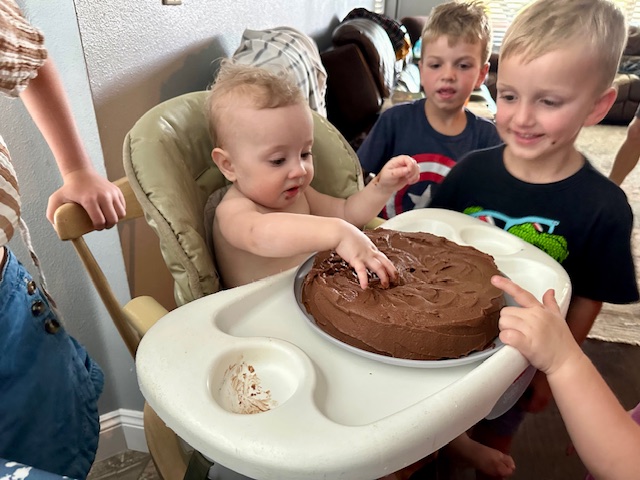
The prevailing experience for children turning a year of age is to give them a cake to do with as they please. A smash cake. The thought is that a child at this age hasn’t ingested a lot of sugar up to this point, so it’s a reward of sorts to let them eat cake.
Kind of like Marie Antoinette.
Thea hasn’t been especially fond of trying new food. She prefers playing with it to actually eating it. She sees her face as a canvas, and food becomes the various hues she applies, smearing with her fingers or a spoon. It’s quite effective, but it’s not long-lasting. Mom comes after her with a washcloth, at which point her voice is raised in protest over the destruction of her work.
That, and she hates having her face washed.
Imagine the delight of a chocolate cake with frosting placed before her, everyone waiting, watching what she would do.
She didn’t disappoint.
There’s a reason they call it a smash cake.
Thea discovered the wonder of sugar and the incredible fun of frosting’s stickiness. She didn’t hesitate to eat what she smushed in her hands.
Thea is expected to be a messy eater. But if one of the older kids tried to get away with smearing food over their faces, they’d be seen as silly or even immature. As you grow up, there’s an expectation of learning manners, such as eating with utensils and chewing with your mouth closed.
There is an assumption that, as we age, we should learn how to act with an understanding of appropriate behavior. Learning to be responsible, respecting others and their possessions, treating others with respect and dignity are all things that should be expected from individuals as they learn to “adult.”
It’s not easy. We live in a culture that hasn’t taught the value of personal responsibility and respect. Too often, things and people are treated as disposable, their value being diminished by what others think they need and want.
Being an adult is expressing a maturity that often isn’t experienced in the world. “Don’t be selfish; don’t try to impress others. Be humble, thinking of others as better than yourselves. Don’t look out only for your own interests, but take an interest in others, too.” Philippians 2:3-4. Being an adult is about being other-focused, not self-focused.
This is a challenge when many are looking to influencers to pattern their lives after. As adults, we’re tasked with making decisions for ourselves based on our circumstances. We grow in this ability as we listen to those who know more than we do, who have more experience, and learn from those who have something valuable to share.
It takes an adult to focus on what matters.
“When I was a child, I spoke and thought and reasoned as a child. But when I grew up, I put away childish things.” 1 Corinthians 13:11. Giving up childish things means moving away from doing things that only satisfy us, and not settling for weak reasoning and limited thoughts. It means being responsible for our own decisions, and not blame-shifting.
Thea can have weak reasoning; she’s one. She knows what she wants and needs; she makes her needs known by her tears and fussiness.
That won’t work in a few years. She will need to learn to grow up.
That is hard, though. Sometimes it’s easier to be a kid, with less responsibility and demands.
It’s not really an option, is it?


 Tip of My Iceberg
Leave a comment