Growing up in the Chicago area, I fully understood the value of garbage being picked up consistently. My dad would call those who participated in such work sanitary engineers; he knew how to put a kind spin on most things. We relied on these people to keep up the look of the neighborhood with their skills and efforts.
I’ve been to New York City when the garbage collectors were on strike, and the smell and amount of trash on the streets were overwhelming. That summer, tourism in the city dropped considerably while the rat population grew exponentially. Disease happened with all the rotting things on street corners. It was a dismal, disgusting space.
Any major city will have its issues with trash collection. Some places are more organic in dealing with garbage; composting is required in some cities, while others don’t even separate the recyclables from the rest of the trash.
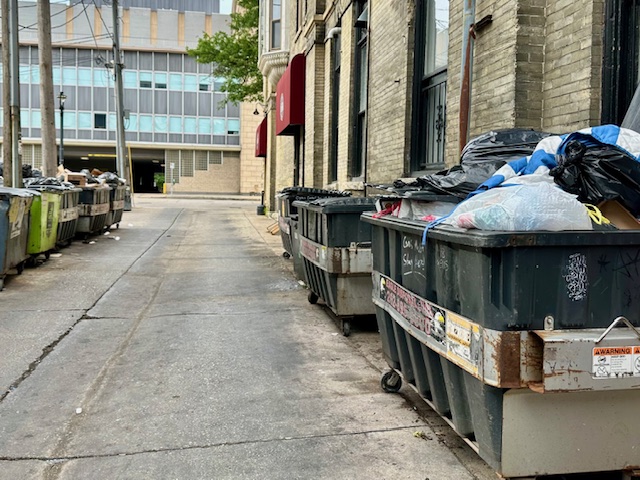
Garbage is a fact of life. As we’ve been in Milwaukee, I’ve often walked by these particular trash receptacles, amazed that they never seem to empty. The stench in that alley causes me to hold my breath as I walk through.
Garbage is a result of life. We are consumers, using things, and discarding what we no longer want. Too often, we’re careless about what we have accumulated, don’t treat it responsibly, and choose to dispose of something rather than recycle or repurpose it. We lack the drive to steward what we have and what we’ve been given.
There are always consequences to poor stewardship: not being trusted with things or people, or losing a relationship because of a lack of respect for what others own.
A steward is a responsible overseer and protector of something worth caring for and preserving. It can be old furniture that needs to be treated with kindness, someone else’s belongings that should be returned in the same shape with which they were shared, or somebody special to another. Biblical stewardship is about managing what God has entrusted to our care.
In the book of Genesis, Adam and Eve, the first people on earth, were given a beautiful garden in which to live. They were tasked by God to tend to this garden.
“The LORD God placed the man in the Garden of Eden to tend and watch over it. But the LORD God warned him, ‘You may freely eat the fruit of every tree in the garden–except the tree of the knowledge of good and evil. If you eat its fruit, you are sure to die.’” Genesis 2:15-17 Their relationship with God in the Garden was close and intimate; there was no shame, guilt, or fear there.
But the two of them chose not to steward this incredible gift well. When Lucifer tempted Eve with the fruit from the forbidden tree, she ignored God’s warning, preferring to satisfy her desire, and ate the fruit, sharing with her husband.
The consequences were swift and harsh. They were forced to leave their personal paradise, and their close relationship with God was broken. He still cared for them; He immediately killed two of his newly created animals to provide garments for them because they’d become aware of shame and their nakedness.
Like the trash in the city, heaped in bins to overflowing, when we disrespect God and His creation, we experience the smelly side of our disobedience.
We all will be wasteful and negligent at some point in our lives. Recognizing that God loves and forgives us for our messiness when we ask, wipes the slate clean in Jesus.
Jesus has collected all the garbage in our lives if we ask. A clean that won’t happen apart from Him.
He is our Holy Sanitary Engineer.


 Tip of My Iceberg
Leave a reply to Willie Torres Jr. Cancel reply