
I’ve been remembering fun snippets of our time in Pennsylvania over Spring Break that have me laughing out loud randomly. People look at me questioningly, but I just shrug and grin.
Sometimes you just have to laugh.
One of the fun things the kids were able to do was drive the Kubota around, a four-wheel drive they’ve named the Tiger because it’s orange. The older ones–think ten-year-olds–were able to try their hand at driving, but sometimes one of the uncles just loaded them up and took off through the fields, cutting through rows of cut corn and soybeans, going faster than the moms watching probably appreciated.
When the uncles drove, everyone was allowed to hang on wherever they could find space. I’d watch as they bounced through the fields, the kids hooting and hollering as they clung to parts of the Kubota. It’s only a two-seater, so with eight kids plus the driver, it was a party on wheels.
Throughout our time together, the goal was to be together, whether it was playing outside, kicking a soccer ball around, or playing board games. There were times when March Madness drew the crowds in–almost everyone there had filled out a bracket. I may have been the only one who didn’t. We made meals together, cleaned up together, ate wherever folks could find a place, but even that was in shared company.
The basement was a kid’s dream, with basketball, foosball, electronic games, ping pong, and a pool table. The bigs and littles could all be together with no one bothering anyone else.
The one room that made me laugh was the bedroom with six queen bunks. Queen beds up and down, enough room for all the kids to sleep there if they wanted.
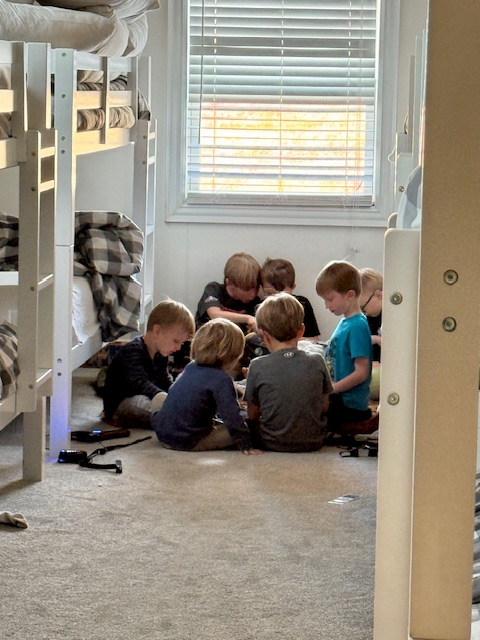
It was made even more fun because the only way you could reach it was a narrow, rickety spiral staircase that shimmied when you went up or down.
It was a time of great inclusion.
Back in Jesus’ day, inclusion wasn’t a value held in high esteem. What Jesus did, eating with outcasts and religious leaders, those who were unclean, and those seen as respectable, was radical. Strangers ate together and became friends. People who had cheated others invited those they’d wronged to their homes and made things right with them over a meal.
Many saw this as questionable and wondered about His purpose, even His identity. He wasn’t worried about His self-image; He didn’t spend time on image management.
What He did do was invite people to hope.
“Are you tired? Worn out? Burned out on religion? Come to Me. Get away with Me and you’ll recover your life. I’ll show you how to take a real rest. Walk with Me and work with Me–watch how I do it. Learn the unforced rhythms of grace. I won’t lay anything heavy or ill-fitting on you. Keep company with Me and you’ll learn to live freely and lightly.” Matthew 11:28-30
What worked for us was everyone being included in what we did: spending time with one another and getting to know family members we don’t see often enough.
Jesus understands that inclusion is one of the most valued social skills. Being part of something bigger and better than just me.
No one means “All aboard” like Jesus does.


 Tip of My Iceberg
Leave a reply to Michael Cancel reply