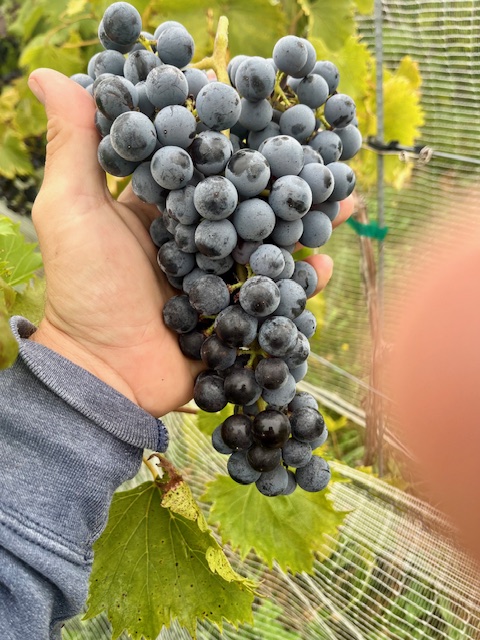
My son and daughter-in-law own a boutique winery in the south-central section of Pennsylvania. Farmland spreads out as far as the eyes can see, with rolling hills of corn, soybeans, and other crops. They planted their vines about four years ago; up to now they’ve purchased grapes and juice from other vineyards to create their wonderfully unique wines. This year is the first where the crop has been appreciable, where they’ve harvested a significant amount to make wine from their own grapes, Chambourcin, a French-American hybrid that has a deep red color and a fruity scent.
This winery has been a dream since they lived in Austin, Texas, where Mark worked nine years at a local winery. The creative process of producing wine from a variety of grapes piqued his curiosity, and he and his wife both took classes in vintnering (growing the grapes) and wine making. The place he worked trusted him enough to allow him to experiment with some varietals, and his vision of their own place began.
They opened Union Cellars as Covid was getting underway in 2020. They built their production room and a tasting room, creating both from an old auto repair shop they purchased.
Wine isn’t the beverage of choice for everyone, but what I appreciate about these two is the commitment to prepare the ground, plant the vines, and grow the grapes, fighting off birds, insects, and a variety of other issues that threatened the thriving of the vines. Mark and Jillian have worked long hours. to get where they are, and they’re hope is to expand and improve their options with new wines.
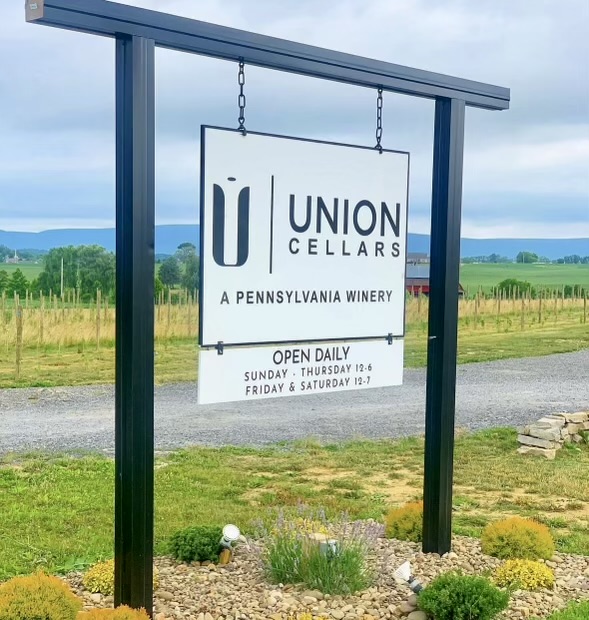
Mark and Jillian have been intentional about what grapes they planted. This wasn’t a haphazard operation. They researched what would grow well and discussed with the nursery where they purchased the vines what would work in their climate. They even visited German wineries, since conditions and soils are similar to that in southern Pennsylvania.
The planted what they wanted to grow.
Vineyards have been around for centuries. The ancient Egyptians and Greeks had wine at their religious ceremonies. The images of vineyards and grape vines are found throughout the Bible. Wine was a common drink in Biblical cultures, shared with family and friends, at celebrations, as gifts, and offerings. It as associated with life and God’s blessings. The alcoholic content of wine then was considerably lower than what it is now.
There is, however, a very simple equation for producing wine. If you want to grow grapes, you have to plant vines. You can’t plant apple seeds and hope to get a thriving grape vine.
Life is similar to that. What we produce in our lives, our work, is whatever efforts, attitudes, and intent we put into it.
We reap what we sow.
“Don’t be misled: No one makes a fool of God. What a person plants, he will harvest. The person who plants selfishness, ignoring the needs of others–ignoring God!–harvests a crop of weeds. All he’ll have to show for his life is weeds! But the one who plants in response to God, letting God’s Spirit do the growth work in him, harvests a crop of real life, eternal life.” Galatians 6:7-8
Just as Mark and Jillian invested in discovering what grapes would grow and produce best, we make an investment in our lives by what we choose to do, who we choose to be with, and our everyday decisions that chart our journey here.
What our lives look like is the culmination of the decisions we make. The seeds of our choices grow a life that reflects those choices.
I want to cultivate who I am so that how I show up in the world represents who I want to be–not who someone else thinks I am or what some group says I am.
God has planted seeds of love, peace, and patience in me that I see growing as my choices remain consistent with His truth.
What kind of life are you growing?


 Tip of My Iceberg
Leave a comment