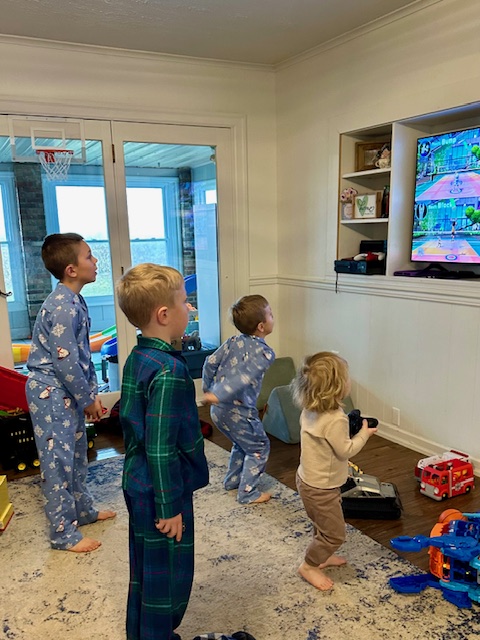
Four boys, ages two to nine. Each highly competitive. All having a longing to win.
Brothers. Six-year-old Mack’s comment said it all: “I don’t like to lose!”
We’ve had the joy of being in Pennsylvania taking care of four very active, very endearing grands who are cut from the same mold–winning is wonderful. Losing, not so much.
Everything is a competition, from the Nintendo Switch to getting into the car first to finishing their dinner before the others are done. They all love sports, so even in kicking a soccer ball around, it’s a chance to prove one’s worth by kicking it the hardest or farthest.
Nobody could identify with that. Right?
Competition colors all of life. The bad brother of competition is comparison–who is better, who has the most likes, who is the greater influencer, who is more talented in–fill in the blank. When winning is the only measure we use to evaluate worth, competition becomes heated.
Simone Biles, the American Olympian gymnast, who won four gold medals, setting the record for the most gold medals in gymnastics in a single Olympics, viewed competition differently. “A successful competition for me is always going out there and putting 100 percent into whatever I’m doing. It’s not always winning. People, I think, mistake that it’s just winning. Sometimes it could be, but for me, it’s hitting the best sets I can, gaining confidence, and having a good time and having fun.” Such a response takes the pressure off competition.
Culture too often forces us into competition. My husband, whose older sister was brilliant, was constantly asked while in school, “Why can’t you be more like your sister?” Parents inadvertently set up competition when they make such mundane comments as, “Let’s see who can clean up their room the fastest,” or “Let’s see who can pick up the most of these dumped crayons.” The intent isn’t to force their kids into competing for an unknown reward, but that’s what’s heard.
Sometimes all we’re looking for is equal opportunity,. A chance to prove ourselves in spite of the competition. Jackie Robinson, the major league baseball player who broke the color barrier commented, “I speak to you only as an American who happens to be an American Negro and one who is proud of that heritage. We ask for nothing special. We ask only that we be permitted to compete on an even basis, and if we are not worthy, then the competition shall, per se, eliminate us.” Equal opportunity provides a level playing field for all of us; the competition then becomes a possibility for all who choose to compete.
The Bible shares many stories of how competition spurs desire.
The mother of James and John, two of Jesus’ disciples, came to ask Jesus to allow her two sons to be able to sit in places of honor next to Him in His kingdom, one on the right and the other on the left. It’s what mothers do, looking out for their own and making sure they get every opportunity due them. It really upset the other ten disciples. But Jesus switched up the focus by explaining the difference between the way people think and the way God thinks.
“You know that the rulers in this world lord it over their people, and officials flaunt their authority over those under them. But among you it will be different. Whoever wants to be a leader among you must be your servant, and whoever wants to be first among you must become your slave. For even the Son of Man came not to be served but to serve others and to give His life as a ransom for many. Matthew 20:25b-28
If winning is the only positive result of competition, very few would ever feel successful.
If we compete with an attitude of humility, not striving to be better than others but to help and serve others, we develop a graciousness not only valued by God but deeply appreciated by those we serve. And even if people aren’t grateful, we’ve chosen to put others ahead of ourselves.
We all hate losing. Humanity focuses on being first and best.
What if choosing to not be first meant improved character, integrity, and dignity? It’s an ethic of valued community that makes people more important than winning.
We need to redefine success.


 Tip of My Iceberg
Leave a comment